College of Science and Mathematics
Course Based Undergraduate Research (CUREs)
"Students enrolled in a course address research problems or questions that are of interest to stakeholders outside of the course." - Working Definition of a CUREs (Dolan & Weaver, 2021)
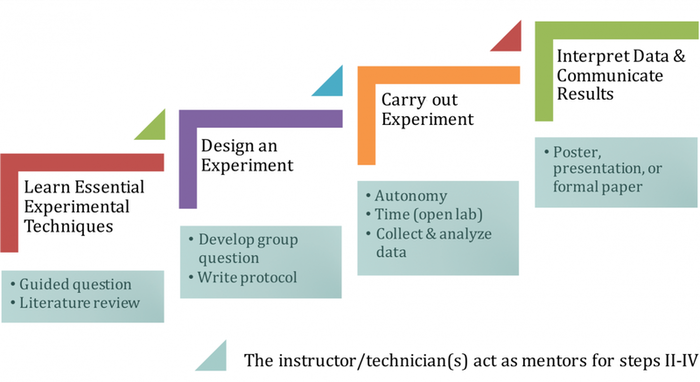
Course-based Undergraduate Research Experiences (CUREs) are a novel form of undergraduate research designed to offer students authentic research experiences within a transformed lab course. CUREs give students the opportunity to gain skills similar to those that would normally be obtained in 1-on-1 faculty-student undergrad research without requiring extra time commitment outside of the course.
The Five Pillars of A CURE
A CUREs, regardless of course implementation or context, will have 5 essential components.
| Feature | Traditional Undergraduate Research | Course-Based Undergraduate Research Experience (CURE) |
|---|---|---|
| Accessibility | Limited to a few students; often requires high GPAs or "who you know" networking. | Democratized. Accessible to any student enrolled in the course. Does not require extra time outside of regularly scheduled class times. |
|
Scaling |
Low. The 1-on-1 faculty/undergrad student relationship requires significant time and guidance, limiting the total students who can participate to a handful (usually). | High. A faculty member can affect all students in their course, and a group/entire department working together can reach hundreds of students per semester. |
| Credit | Often Extracurricular or Volunteer-Based. Within the CSM, students may also have the opportunity to earn credits through Honors or T credits. | Curricular. Students earn college credits while performing undergrad research. |
| Equity | Exclusive. Can favor students who have awareness of cultural norms, experience with faculty interaction, and financial ability associated with participating in a research opportunity (Bangera & Brownell, 2014). | Inclusive. Students don't have to choose between working/being parents/other obligations and partipating in research. |
Erin Dolan - Course Based Undergraduate Research Experience Book
Goal Alignment Worksheet
So you have read through the material and are ready to try implementing a CURE within your course. Glad to hear! The CSM offers funding to support your efforts. Funding can cover expenses required of your CURE, including student assistant pay (up to certain amounts). We currently have the following funding opportunities.
CSM CUREs Funding
STEAM CUREs Funding*
Faculty will be required to add an assessment piece and submit a report at the end
of the semester with information on implementation.
[Button Here - APPLY FOR CURES FUNDING]
*STEAM professional development workshop participation required
Within the CSM, CUREs are currently or have previously been implemented within...
Are you or have you run a CUREs course and it is not listed here? Complete the following CUREs in CSM survey or reach out to Alejandro Mendez(alexandros@mail.fresnostate.edu) to be added. Get recognized for your efforts!
Questions/Comments/Concerns Contact:
Alejandro Mendez
CSM High Impact Practices Coordinator
alexandros@mail.fresnostate.edu
559.278.1345